


When someone needs a local service, they rarely begin with the name of a particular business.
They search—or increasingly ask:
- “Who is the best dog groomer near me?”
- “Which local builder has the most trustworthy reviews?”
- “Can you recommend an educational consultant in Sussex?”
- “Where is the best place nearby for this service?”
Google, Maps and AI-powered search tools then try to identify the businesses most likely to answer that person’s needs.
But how do they decide who deserves to be visible—and who gets recommended?
There is no magic button, single ranking trick or guaranteed formula. Instead, these platforms look for a collection of signals that help them understand three things:
What does this business do?
Can it genuinely serve this customer?
Does it appear trustworthy enough to recommend?
How Google chooses local businesses
Google explains that local results are mainly based on three factors:
- Relevance
- Distance
- Prominence
These factors work together, which is why the business with the most reviews—or the one physically closest to the customer—will not automatically appear first every time.:
1. Relevance: Does your business match the search?
Relevance is about how closely your business information matches what the customer is looking for.
Google needs to understand:
- What your business does
- Which services you provide
- Which customers you help
- Where you provide those services
- What makes your business relevant to this particular search
A complete and accurate Google Business Profile helps Google build that understanding.
Your primary and additional business categories, services, description, website content, photographs, opening hours and other details all contribute to the wider picture.
If your profile simply says “Consultant,” but your website clearly explains that you provide educational consultancy, workshops and speaking engagements across Sussex, Google has much more useful context.
Specific information removes ambiguity.
2. Distance: Can you realistically serve the customer?
Distance considers how close the business is to the location used in the search.
Sometimes the customer includes a place:
“Dog groomer in Battle.”
At other times, Google estimates the customer’s location from the information available to it.
Businesses cannot control where every customer searches from. However, they can help Google understand where they genuinely operate by keeping their address or service areas accurate.
This is particularly important for service-area businesses that visit customers rather than welcoming them to a public shopfront.
Adding dozens of towns you do not realistically serve will not create genuine local relevance. Clear, accurate coverage is much more valuable than trying to appear everywhere.
3. Prominence: Is your business established and trusted?
Prominence broadly considers how well-known and credible a business appears.
Google may consider information from across the web, including:
- Your Google Business Profile
- Customer reviews and ratings
- Your website
- Links to your website
- Business directories
- Articles and other online mentions
- The business’s position in ordinary search results
Google confirms that more reviews and positive ratings can help a business’s local ranking, although reviews are only one element of the complete picture.
A business with accurate information, a useful website, genuine reviews and a consistent presence across the web sends stronger signals than one with incomplete details and little visible evidence.
Google summarises its local-ranking approach as relevance, distance and prominence. Google Business Profile guidance ↗
Where customer reviews fit
Reviews help platforms and potential customers understand what people actually experience when they use your business.
A healthy review profile can communicate:
- That the business is active
- That customers genuinely use its services
- Which services people value
- Where customers are located
- Whether experiences are consistently positive
- How the business responds when customers communicate
For example, a review might mention:
“Claire was wonderful with my nervous cockapoo and created such a calm one-to-one grooming experience.”
That review does more than award five stars. It helps people—and potentially search systems—understand that the business offers cockapoo grooming, supports nervous dogs and provides a calm, individual experience.
Reviews should never be forced, purchased or manipulated. Their value comes from being authentic evidence of real customer experiences.
Google itself says reviews can help a business stand out and provide potential customers with useful information. Google’s review guidance ↗
Why recent activity matters
Imagine two otherwise similar businesses.
One has excellent reviews, but the most recent was left three years ago.
The other has a steady flow of genuine feedback, current photographs, accurate opening hours, fresh website content and thoughtful responses from the owner.
Which one appears more active today?
Freshness does not mean constantly changing information for the sake of it. It means keeping your online presence aligned with the business that currently exists.
Useful activity may include:
- Receiving new customer reviews naturally
- Responding to existing reviews
- Updating services and opening hours
- Adding genuine business photographs
- Publishing helpful articles
- Keeping your website accurate
- Sharing relevant business updates
Consistency helps demonstrate that the business is operating, attentive and engaged with its customers.
How AI recommendations are different
Traditional search generally presents a list of results.
AI-powered search may go a step further by summarising information and producing a direct response, such as:
“Based on strong customer feedback and relevant local services, these businesses may be worth considering.”
However, there is no single universal system used by every AI platform.
Different tools may draw from different combinations of:
- Search indexes
- Business profiles
- Websites
- Maps and location information
- Public reviews
- Directories
- News articles
- Videos
- Community discussions
- Other publicly accessible sources
Google explains that its generative AI search features remain rooted in its core Search ranking and quality systems. They retrieve relevant, current web pages from Google’s index and use those sources to construct useful responses with supporting links. Google’s AI Search guidance ↗
That means the foundations of good search visibility still matter in an AI-search world.
AI does not remove the need for SEO, accurate information or trustworthy content. It increases the importance of making your business easy to understand across multiple reliable sources.
Can AI understand your business clearly?
Before an AI tool can confidently recommend your business, it needs enough dependable information to understand it.
Consider whether your online presence answers these questions:
- What exactly does the business offer?
- Who is it designed to help?
- Where does it provide its services?
- What experience or qualifications support its claims?
- What do real customers say?
- Is the information consistent across different platforms?
- Is the website current and accessible?
- Is there enough evidence to distinguish it from similarly named businesses?
If one platform says you are a consultant, another says software company and your website appears to be only an online shop, the overall picture may be unclear.
That does not mean every description must be identical. It means they should all tell a compatible story.
Your website helps connect the evidence
Your Google Business Profile may introduce the business, but your website gives you room to explain it properly.
A useful local-business website should clearly communicate:
- Your principal services
- Your location or service areas
- Who you help
- Your experience and expertise
- Customer testimonials
- How to contact or book you
- Answers to common customer questions
Helpful articles can deepen that understanding by answering the real questions customers ask before making a decision.
Google recommends creating original, useful and people-first content rather than publishing pages designed primarily to manipulate rankings. Google’s helpful-content guidance ↗
The aim is not to write robotic content “for AI.”
The aim is to make your expertise genuinely useful and understandable.
Structured information provides additional clarity
Behind the visible website, structured data can provide search engines with explicit clues about the information on a page.
For a local business, this may help identify details such as:
- Business name
- Business type
- Address
- Opening hours
- Telephone number
- Website
- Relevant business information
Google describes structured data as a standardised format for explaining and classifying page content. LocalBusiness structured data can help Google understand details about a business, although it does not guarantee higher rankings or a particular search appearance. Google’s LocalBusiness structured-data guidance ↗
Think of it as clarity—not a shortcut.
What helps a business become recommendable?
There is no way to guarantee that Google or an AI platform will recommend a particular business.
However, you can create a stronger, clearer and more trustworthy digital presence.
Focus on:
Accurate information
Keep your business name, contact details, categories, services, hours and service areas correct.
Genuine customer feedback
Build a steady process for requesting honest reviews from real customers.
Thoughtful responses
Reply professionally and personally to feedback so customers can see that you listen and care.
A helpful website
Explain your services clearly and answer the questions customers genuinely ask.
Consistency across platforms
Make sure your website, Google profile, review platforms, directories and social channels describe the same real business.
Useful, original content
Share genuine expertise, insights, images, case studies and examples that another generic website could not simply reproduce.
Strong technical foundations
Ensure your website can be accessed, crawled and understood by search engines.
From being visible to being chosen
Appearing in a search result is valuable.
Being recommended is stronger.
But even a recommendation is not the final goal.
The customer still needs to feel confident enough to click, visit your website, read your reviews and take the next step.
That is why the complete journey matters:
Accurate information helps platforms understand you.
Visibility helps customers discover you.
Reviews help them trust you.
Your website helps them understand your value.
A clear booking journey helps them choose you.
Each part supports the next.
Make your business easier to find, trust and recommend
Raving Reviews by CreateFlow helps businesses build and manage the customer-review signals that support trust and visibility.
It helps you request genuine feedback, respond consistently and showcase your strongest customer experiences across your online presence.
Where needed, CreateFlow can also help strengthen the wider journey through Google Business Profile support, relevant content, converting pages, booking funnels, email follow-up and automation.
Because the aim is not simply to appear online.
It is to become the business that customers—and the platforms helping them decide—can understand, trust and confidently choose.
Would you like to discover how visible and recommendable your business currently appears?
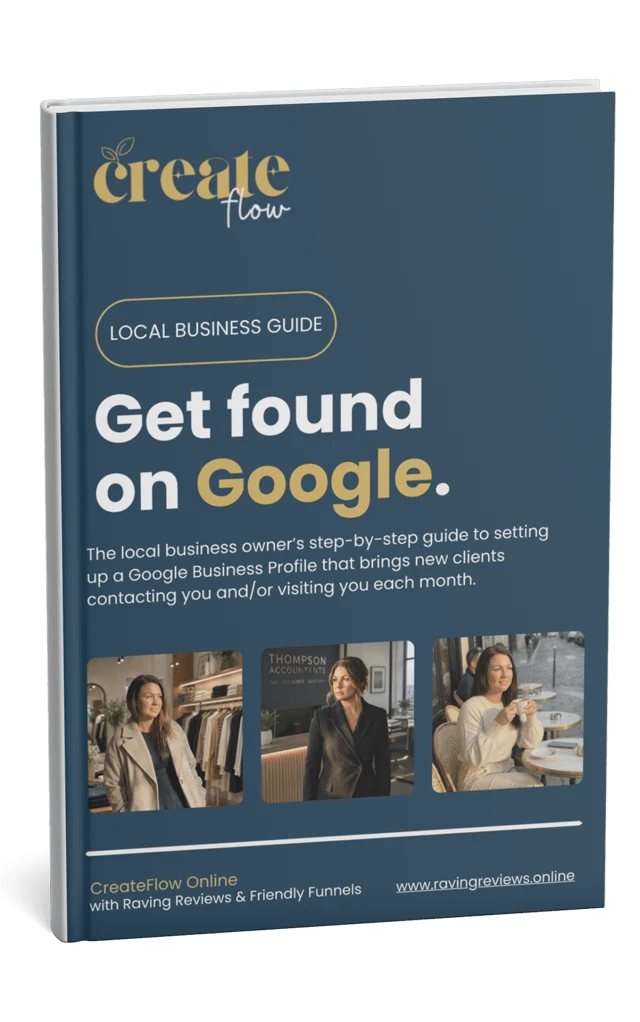
Free guide
Get found on Google.
The step-by-step guide to setting up a Google Business Profile that brings new clients contacting and visiting you each month.
Check your inbox.
Your guide is on its way. If it isn’t there in a few minutes, have a look in your spam or promotions folder.
Preview only: on the live site this sends the guide from Systeme.